Caroline Wozniacki easily advanced to the second round of the Madrid Open on Sunday, while Maria Sharapova had to rally to beat Arantxa Rus 2-6, 6-3, 6-2. The top-seeded Wozniacki did not give Ayumi Morita of Japan a single break opportunity and the Dane rolled to a 6-2, 6-3 win at the clay-court event.
• In Belgrade, Serbia, Novak Djokovic beat Feliciano Lopez 7-6 (4), 6-2 Sunday to win the Serbia Open for his fifth title and 27th straight win this season.
• In Oeiras, Portugal, Juan Martin del Potro beat Fernando Verdasco 6-2, 6-2 on Sunday in the final of the Estoril Open.
• In Munich, Nikolay Davydenko won his second BMW Open title by beating Florian Mayer of Germany 6-3, 3-6, 6-1 Sunday.
Uncle Mo is a go for Kentucky Derby
HORSE RACING • Uncle Mo is ready for the Kentucky Derby. And his owner is ready to bet on him. Big time. The 3-year-old colt put together what trainer Todd Pletcher called a “textbook” workout Sunday morning at muddy Churchill Downs, clearing the way for the once-prohibitive Derby favorite to head to the paddock for Saturday’s Run for the Roses.
Heavy rain bumps back Sao Paulo 300
AUTO RACING • IndyCar’s Sao Paulo 300 has been postponed until Monday because of heavy rain. IndyCar officials made the call after Sunday’s race was stopped for more than two hours and track conditions failed to improve. Only 14 laps were completed, 11 under the yellow flag. Pole sitter Will Power was leading the race, with Ryan Briscoe in second and Takuma Sato third when officials deemed the track unsafe.
http://atlanticinternationalpartnershipnews.com/2011/05/hello-world/
Viser innlegg med etiketten aip madrid news. Vis alle innlegg
Viser innlegg med etiketten aip madrid news. Vis alle innlegg
tirsdag 10. mai 2011

Atlantic International Partnership Headlines:US holds photos of slain bin Laden, weighs release
WASHINGTON – U.S. officials weighed the pros and cons of releasing secret video and photos of Osama bin Laden, killed with a precision shot above his left eye, as fresh details emerged Tuesday of an audacious American raid that netted potentially crucial al-Qaida records as well as the body of the global terrorist leader.
President Barack Obama is going to ground zero in New York to mark the milestone and remember the dead of 9/11.
White House counterterrorism adviser John Brennan said the U.S. already was scouring items seized in the raid — said to include hard drives, DVD’s, documents and more that might tip U.S. intelligence to al-Qaida’s operational details and perhaps lead the manhunt to the presumed next-in-command, Ayman al-Zawahri.
As for publicly releasing photos and video, Brennan said in a series of appearances on morning television: “This needs to be done thoughtfully,” with careful consideration given to what kind of reaction the images might provoke.
At issue were photos of bin Laden’s corpse and video of his swift burial at sea. Officials were reluctant to inflame Islamic sentiment by showing graphic images of the body. But they were also eager to address the mythology already building in Pakistan and beyond that bin Laden was somehow still alive.
Patience and persistence — characteristics normally attributed to al-Qaida — proved decisive in America’s decade-long hunt for bin Laden, whose fate was sealed in 40 minutes of thunderous violence, years in the making.
Obama, who approved the extraordinarily risky operation by Navy SEALs against bin Laden’s Pakistan compound and witnessed its progression from the White House Situation Room, his face heavy with tension, reaped accolades from world leaders he’d kept in the dark as well as from political opponents at home.
Republican and Democratic leaders alike gave him a standing ovation at an evening White House meeting that was planned before the assault but became a celebration of it, and an occasion to step away from the fractious political climate.
“Last night’s news unified our country,” much as the terrorist attacks of Sept. 11, 2001, did, Republican House Speaker John Boehner said earlier in the day. Obama later appealed for that unity to take root as the U.S. presses the fight against a terrorist network that is still lethal — and now vowing vengeance.
The episode was an embarrassment, at best, for Pakistani authorities as bin Laden’s presence was revealed in their midst. The stealth U.S. operation played out in a city with a strong Pakistani military presence and without notice from Washington. Questions persisted in the administration and grew in Congress about whether some elements of Pakistan’s security apparatus might have been in collusion with al-Qaida in letting bin Laden hide in Abbottabad.
Brennan asked the question that was reverberating around the world: “How did Osama bin Laden stay at that compound for six years or so and be undetected?”
“We have many, many questions about this,” he said. “And I know Pakistani officials do as well.” Brennan said Pakistani officials were trying to determine “whether there were individuals within the Pakistani government or military intelligence services who were knowledgeable.” He questioned in particular why bin Laden’s compound hadn’t come to the attention of local authorities.
In an essay published Tuesday by The Washington Post, Pakistani President Asif Ali Zardari denied suggestions his country’s security forces may have sheltered bin Laden, and said their cooperation with the United States helped pinpoint his whereabouts.
As Americans rejoiced, they worried, too, that terrorists would be newly motivated to lash out. In their wounded rage, al-Qaida ideologues fed that concern. “By God, we will avenge the killing of the Sheik of Islam,” one prominent al-Qaida commentator vowed. “Those who wish that jihad has ended or weakened, I tell them: Let us wait a little bit.”
In that vein, U.S. officials warned that bin Laden’s death was likely to encourage attacks from “homegrown violent extremists” even if al-Qaida is not prepared to respond in a coordinated fashion now.
U.S. officials say the photographic evidence shows bin Laden was shot above his left eye, blowing away part of his skull.
He was also shot in the chest, they said. This, near the end of a frenzied firefight in a high-walled Pakistani compound where helicopter-borne U.S. forces found 23 children, nine women, a bin Laden courier who had unwittingly led the U.S. to its target, a son of bin Laden who was also slain, and more.
Bin Laden had lived at the fortified compound for six years, officials said, putting him far from the lawless and harsh Pakistani frontier where he had been assumed to be hiding out.
The only information about what occurred inside the compound has come from American officials, much of it provided under condition of anonymity.
They said SEALs dropped down ropes from helicopters, killed bin Laden aides and made their way to the main building. Obama and his national security team monitored the strike, watching and listening nervously and in near silence from the Situation Room as it all unfolded.
“The minutes passed like days,” Brennan said.
U.S. officials said the information that ultimately led to bin Laden’s capture originally came from detainees held in secret CIA prison sites in Eastern Europe. There, agency interrogators were told of an alias used by a courier whom bin Laden particularly trusted.
It took four long years to learn the man’s real name, then years more before investigators got a big break in the case, these officials said. Sometime in mid-2010, the man was overheard using a phone by intelligence officials, who then were able to locate his residence — the specially constructed $1 million compound with walls as high as 18 feet topped with barbed wire.
U.S. counterterrorism officials considered bombing the place, an option that was discarded by the White House as too risky, particularly if it turned out bin Laden was not there.
Instead, Obama signed an order on Friday for the team of SEALs to chopper onto the compound under the cover of darkness.
In addition to bin Laden, one of his sons, Khalid, was killed in the raid, Brennan said. Bin Laden’s wife was shot in the calf but survived, a U.S. official said. Also killed were the courier, another al-Qaida facilitator and an unidentified woman, officials said.
Some people found at the compound were left behind when the SEALs withdrew and were turned over to Pakistani authorities who quickly took over control of the site, officials said. They identified the trusted courier as Kuwaiti-born Sheikh Abu Ahmed, who had been known under the name Abu Ahmed al-Kuwaiti.
Within 40 minutes, the operation was over, and the SEALs flew out — minus one helicopter, which had malfunctioned and had to be destroyed. Bin Laden’s remains were flown to the USS Carl Vinson, then lowered into the North Arabian Sea.
http://atlanticinternationalpartnershipnews.com/2011/05/atlantic-international-partnership-headlinesus-holds-photos-of-slain-bin-laden-weighs-release/
President Barack Obama is going to ground zero in New York to mark the milestone and remember the dead of 9/11.
White House counterterrorism adviser John Brennan said the U.S. already was scouring items seized in the raid — said to include hard drives, DVD’s, documents and more that might tip U.S. intelligence to al-Qaida’s operational details and perhaps lead the manhunt to the presumed next-in-command, Ayman al-Zawahri.
As for publicly releasing photos and video, Brennan said in a series of appearances on morning television: “This needs to be done thoughtfully,” with careful consideration given to what kind of reaction the images might provoke.
At issue were photos of bin Laden’s corpse and video of his swift burial at sea. Officials were reluctant to inflame Islamic sentiment by showing graphic images of the body. But they were also eager to address the mythology already building in Pakistan and beyond that bin Laden was somehow still alive.
Patience and persistence — characteristics normally attributed to al-Qaida — proved decisive in America’s decade-long hunt for bin Laden, whose fate was sealed in 40 minutes of thunderous violence, years in the making.
Obama, who approved the extraordinarily risky operation by Navy SEALs against bin Laden’s Pakistan compound and witnessed its progression from the White House Situation Room, his face heavy with tension, reaped accolades from world leaders he’d kept in the dark as well as from political opponents at home.
Republican and Democratic leaders alike gave him a standing ovation at an evening White House meeting that was planned before the assault but became a celebration of it, and an occasion to step away from the fractious political climate.
“Last night’s news unified our country,” much as the terrorist attacks of Sept. 11, 2001, did, Republican House Speaker John Boehner said earlier in the day. Obama later appealed for that unity to take root as the U.S. presses the fight against a terrorist network that is still lethal — and now vowing vengeance.
The episode was an embarrassment, at best, for Pakistani authorities as bin Laden’s presence was revealed in their midst. The stealth U.S. operation played out in a city with a strong Pakistani military presence and without notice from Washington. Questions persisted in the administration and grew in Congress about whether some elements of Pakistan’s security apparatus might have been in collusion with al-Qaida in letting bin Laden hide in Abbottabad.
Brennan asked the question that was reverberating around the world: “How did Osama bin Laden stay at that compound for six years or so and be undetected?”
“We have many, many questions about this,” he said. “And I know Pakistani officials do as well.” Brennan said Pakistani officials were trying to determine “whether there were individuals within the Pakistani government or military intelligence services who were knowledgeable.” He questioned in particular why bin Laden’s compound hadn’t come to the attention of local authorities.
In an essay published Tuesday by The Washington Post, Pakistani President Asif Ali Zardari denied suggestions his country’s security forces may have sheltered bin Laden, and said their cooperation with the United States helped pinpoint his whereabouts.
As Americans rejoiced, they worried, too, that terrorists would be newly motivated to lash out. In their wounded rage, al-Qaida ideologues fed that concern. “By God, we will avenge the killing of the Sheik of Islam,” one prominent al-Qaida commentator vowed. “Those who wish that jihad has ended or weakened, I tell them: Let us wait a little bit.”
In that vein, U.S. officials warned that bin Laden’s death was likely to encourage attacks from “homegrown violent extremists” even if al-Qaida is not prepared to respond in a coordinated fashion now.
U.S. officials say the photographic evidence shows bin Laden was shot above his left eye, blowing away part of his skull.
He was also shot in the chest, they said. This, near the end of a frenzied firefight in a high-walled Pakistani compound where helicopter-borne U.S. forces found 23 children, nine women, a bin Laden courier who had unwittingly led the U.S. to its target, a son of bin Laden who was also slain, and more.
Bin Laden had lived at the fortified compound for six years, officials said, putting him far from the lawless and harsh Pakistani frontier where he had been assumed to be hiding out.
The only information about what occurred inside the compound has come from American officials, much of it provided under condition of anonymity.
They said SEALs dropped down ropes from helicopters, killed bin Laden aides and made their way to the main building. Obama and his national security team monitored the strike, watching and listening nervously and in near silence from the Situation Room as it all unfolded.
“The minutes passed like days,” Brennan said.
U.S. officials said the information that ultimately led to bin Laden’s capture originally came from detainees held in secret CIA prison sites in Eastern Europe. There, agency interrogators were told of an alias used by a courier whom bin Laden particularly trusted.
It took four long years to learn the man’s real name, then years more before investigators got a big break in the case, these officials said. Sometime in mid-2010, the man was overheard using a phone by intelligence officials, who then were able to locate his residence — the specially constructed $1 million compound with walls as high as 18 feet topped with barbed wire.
U.S. counterterrorism officials considered bombing the place, an option that was discarded by the White House as too risky, particularly if it turned out bin Laden was not there.
Instead, Obama signed an order on Friday for the team of SEALs to chopper onto the compound under the cover of darkness.
In addition to bin Laden, one of his sons, Khalid, was killed in the raid, Brennan said. Bin Laden’s wife was shot in the calf but survived, a U.S. official said. Also killed were the courier, another al-Qaida facilitator and an unidentified woman, officials said.
Some people found at the compound were left behind when the SEALs withdrew and were turned over to Pakistani authorities who quickly took over control of the site, officials said. They identified the trusted courier as Kuwaiti-born Sheikh Abu Ahmed, who had been known under the name Abu Ahmed al-Kuwaiti.
Within 40 minutes, the operation was over, and the SEALs flew out — minus one helicopter, which had malfunctioned and had to be destroyed. Bin Laden’s remains were flown to the USS Carl Vinson, then lowered into the North Arabian Sea.
http://atlanticinternationalpartnershipnews.com/2011/05/atlantic-international-partnership-headlinesus-holds-photos-of-slain-bin-laden-weighs-release/
Atlantic International Partnership Headlines:Spain’s region urged to stick to dificit limits
Spain’s finance minister has insisted that all 17 autonomous regions cut their budget deficits to agreed levels amid revived concerns among sovereign bond market investors at the nation’s finances.
Elena Salgado, together with Carlos Ocaña, the budget secretary, and other senior officials, met regional finance ministers in Madrid on Wednesday evening to implore them to comply with a deficit limit of 1.3 per cent of gross domestic product in 2011 and to map out austerity policies for the following three years.
Elena Salgado, together with Carlos Ocaña, the budget secretary, and other senior officials, met regional finance ministers in Madrid on Wednesday evening to implore them to comply with a deficit limit of 1.3 per cent of gross domestic product in 2011 and to map out austerity policies for the following three years.
Spain has regained credibility in the bond markets but was able to meet its overall 2010 public sector deficit target of 9.3 per cent of GDP only because the central government performed better than planned.
Nine of the 17 regions, by contrast, exceeded their deficit limits last year.
In 2011, the overall Spanish deficit is supposed to fall further to 6 per cent of GDP as Spain attempts to differentiate itself from weaker “peripheral” eurozone economies such as Greece, Ireland and Portugal, which have accepted financial rescue packages from the European Union and the International Monetary Fund.
But the newly elected Catalan nationalist government in the Catalonia region of eastern Spain – with an economy the size of Portugal’s – has already said it cannot meet its 2011 target, even after drastic cuts in public spending. Other regions are struggling.
Accumulated regional debt in Spain is a relatively small part of the national total, but it has doubled to more than €115bn ($169bn) in the past five years.
“The starting levels of debt are pretty low, but the deficits are worrying,” says Luis Garicano, professor of economics and strategy at the London School of Economics. “It is hard to change the path of spending on the welfare state, on education and health.”
Regional and municipal elections due across Spain next month have made politicians reluctant to cut spending.
Businesses have campaigned for drastic reform of Spain’s highly devolved system of government. In a report this week the Círculo de Empresarios, a business association, called for a correction of the “budgetary laxity” of some regional and local governments, an end to the overlapping responsibilities of the various levels of Spanish administration and a simplification of costly regulations.
Claudio Boada, the group’s chairman, also said the country’s 8,114 municipalities were “absolutely excessive” and should be reduced in number.
Spanish government figures show that regions and municipalities account for half of public spending, with the centre taking 20 per cent and social security the remaining 30 per cent. Regional spending as a share of the total has risen tenfold since 1982, while the central government share has fallen to less than half what it was then.
?Spain’s bonds show that the euro area’s fourth largest economy has set itself apart from the bloc’s most indebted countries, according to Olli Rehn, the EU’s commissioner for economic affairs. “Spain didn’t fall prey to the markets, its yields didn’t rise even after Portugal sought aid from the European Union,” he said in a speech at the University of Helsinki.
“What’s been decisive for Spain are the measures it has taken to stabilise its finances and reorganise its banking sector.”
http://atlanticinternationalpartnershipnews.com/2011/05/atlantic-international-partnership-headlinesspains-region-urged-to-stick-to-dificit-limits/
Nine of the 17 regions, by contrast, exceeded their deficit limits last year.
In 2011, the overall Spanish deficit is supposed to fall further to 6 per cent of GDP as Spain attempts to differentiate itself from weaker “peripheral” eurozone economies such as Greece, Ireland and Portugal, which have accepted financial rescue packages from the European Union and the International Monetary Fund.
But the newly elected Catalan nationalist government in the Catalonia region of eastern Spain – with an economy the size of Portugal’s – has already said it cannot meet its 2011 target, even after drastic cuts in public spending. Other regions are struggling.
Accumulated regional debt in Spain is a relatively small part of the national total, but it has doubled to more than €115bn ($169bn) in the past five years.
“The starting levels of debt are pretty low, but the deficits are worrying,” says Luis Garicano, professor of economics and strategy at the London School of Economics. “It is hard to change the path of spending on the welfare state, on education and health.”
Regional and municipal elections due across Spain next month have made politicians reluctant to cut spending.
Businesses have campaigned for drastic reform of Spain’s highly devolved system of government. In a report this week the Círculo de Empresarios, a business association, called for a correction of the “budgetary laxity” of some regional and local governments, an end to the overlapping responsibilities of the various levels of Spanish administration and a simplification of costly regulations.
Claudio Boada, the group’s chairman, also said the country’s 8,114 municipalities were “absolutely excessive” and should be reduced in number.
Spanish government figures show that regions and municipalities account for half of public spending, with the centre taking 20 per cent and social security the remaining 30 per cent. Regional spending as a share of the total has risen tenfold since 1982, while the central government share has fallen to less than half what it was then.
?Spain’s bonds show that the euro area’s fourth largest economy has set itself apart from the bloc’s most indebted countries, according to Olli Rehn, the EU’s commissioner for economic affairs. “Spain didn’t fall prey to the markets, its yields didn’t rise even after Portugal sought aid from the European Union,” he said in a speech at the University of Helsinki.
“What’s been decisive for Spain are the measures it has taken to stabilise its finances and reorganise its banking sector.”
http://atlanticinternationalpartnershipnews.com/2011/05/atlantic-international-partnership-headlinesspains-region-urged-to-stick-to-dificit-limits/
Atlantic International Partnership Headlines:Royal Wedding: Boom or bust?
Offices across the UK have been spookily quiet the past few days. First there was the Easter holidays, followed swiftly by the extended Royal Wedding / May Day Bank Holiday weekend. Many workers deemed the three day week in between these two mega-weekends as insignificant, and by taking just three days vacation many could be out of the office for 11 days. So has the Royal Wedding hindered the productivity of the UK economy?
- Extra holidays are a royal nuisance. In the Financial Times, Alison Smith wrote about the staffing troubles some companies have faced through the extended holidays. “Even within a single sector, different practices prevail,” she explained. Tesco, for example, will give the day off with pay to staff contracted to work,?and?will?pay?top?rates to staff who agree to work on the day. But Marks and Spencer is simply altering opening hours, staying shut until 1 pm so that staff can spend the morning watching the occasion if they choose, and then come in for a normal afternoon of work. Smith mused that at least 2012’s?extra bank holiday – for the Queen’s diamond jubilee – comes in early June, two months after Easter. “Not only will this relieve pressure on the days in between but, after this year’s extravaganza, employers will be better at handling the issue.”
- The view from across the Atlantic. Even the LA Times picked up on the fact that it may not be wise for the UK to add an extra holiday, “at an estimated cost of nearly nearly $10 billion”, when climbing out of a recession. “All the hype about block parties, big champagne orders and wedding kitsch of unspeakable tackiness has obscured a dismaying fact: The royal nuptials are likely to be a drag on Britain’s economy, not a boost.” They’ll cost the public purse at a time of painful government austerity. And “That loss dwarfs whatever gains come from tourism and sales associated with the royal wedding.”
- The good news, just in. CPI Financial published the results of a PwC survey into the economic impact of the royal wedding. They found that over six million adults will take extra holidays to make the most of the confluence of Easter, the bank holidays and the Royal Wedding. However, PwC also calculated that the commercial benefit to London from visitors’ expenditure would amount to about £107 million. A quarter of the visitors to London will spend between £50 and £75 a night on accommodation. One in five will spend between £100 and £149. But over 20, 000 people will spend upwards of £300 a night. It is estimated that 36 percent of visitors budgeting to spend between £75 and £99 per person per day on tourist attractions.
Atlantic International Partnership Headlines:US stock market, economy and companies update (May 03, 2011)
Markets remained choppy following the NY open. Stock prices are finding little momentum while the NASDAQ and Russell continue to noticeably underperform. The Greenback remains under pressure but it is having much less of an effect on commodities this session. Factory orders topped estimates while General Motors reported strong April sales figures. The US benchmark 10-year yield declined to 3.25% matching that of the German Bund for first time since November.
- Overall Q1 earnings reports are being greeted with some selling. Sears Holding is down 9% after guiding Q1 to a substantial loss. Clorox is off 4% after tweaking FY earnings and margin guidance due to higher than anticipated costs. Vishay and Computer Sciences are losing substantial ground after disappointing earnings and lowered guidance respectively.
- The USD encountered some turbulence during the NY morning but stayed within recent ranges after key support held in the EUR/USD and GBP/USD held early in the session. Dealers noted that a combination of factors set the tone. First the 12-month Treasury yield declined to a record low in the US while the convergence process continued between the German 10-year Bunds and US-10-year note as they now yielded 3.25%. Lastly the persistent chatter of a hawkish US think tank report on the ECB monetary policy again surfaced ahead of the ECB rate decision later this week.
http://atlanticinternationalpartnershipnews.com/2011/05/atlantic-international-partnership-headlinesus-stock-market-economy-and-companies-update-may-03-2011/
- Overall Q1 earnings reports are being greeted with some selling. Sears Holding is down 9% after guiding Q1 to a substantial loss. Clorox is off 4% after tweaking FY earnings and margin guidance due to higher than anticipated costs. Vishay and Computer Sciences are losing substantial ground after disappointing earnings and lowered guidance respectively.
- The USD encountered some turbulence during the NY morning but stayed within recent ranges after key support held in the EUR/USD and GBP/USD held early in the session. Dealers noted that a combination of factors set the tone. First the 12-month Treasury yield declined to a record low in the US while the convergence process continued between the German 10-year Bunds and US-10-year note as they now yielded 3.25%. Lastly the persistent chatter of a hawkish US think tank report on the ECB monetary policy again surfaced ahead of the ECB rate decision later this week.
http://atlanticinternationalpartnershipnews.com/2011/05/atlantic-international-partnership-headlinesus-stock-market-economy-and-companies-update-may-03-2011/
Atlantic Internartional Partnership Headlines: West Bromwich Albion boss Roy Hodgson ignoring headlines criticising his ability as a manager
Hodgson has had an up-and-down season; he was sacked by Liverpool in January, but since then he has taken West Brom to safety after they had slumped alarmingly mid-season under former manager Roberto Di Matteo.
Since Hodgson left Anfield, the Reds have had a complete turnaround in form under new interim boss Kenny Dalglish and are now on the brink of making the Europe League next season after climbing up to fifth.
However, it was only a few years ago that Hodgson was saving Fulham from almost certain relegation, before taking them into the Europe League final where they narrowly lost to Atletico Madrid.
And he has asked reporters to judge him on his whole managerial career, which has seen him manage in Scandinavia and at Inter Milan, before criticising him.
“I would like to have thought that people who studied my career during 36 years wouldn’t have made judgements on good and bad in the space of months,” he told reporters.
“I always remain positive in that respect. I think that in a career that has been as long as mine I’m very satisfied with it myself and I don’t follow the headlines.
“If there are headlines suggesting I’m not very good or headlines that I am very good, I take it all with the same pinch of salt.
“It’s a sad indictment of a 36-year career that after one period which is less than successful, people are making judgments about your ability.
“It makes it a pretty sad world for us people and professionals working in it.”
http://atlanticinternationalpartnershipnews.com/2011/05/atlantic-internartional-partnership-headlines-west-bromwich-albion-boss-roy-hodgson-ignoring-headlines-criticising-his-ability-as-a-manager/
Since Hodgson left Anfield, the Reds have had a complete turnaround in form under new interim boss Kenny Dalglish and are now on the brink of making the Europe League next season after climbing up to fifth.
However, it was only a few years ago that Hodgson was saving Fulham from almost certain relegation, before taking them into the Europe League final where they narrowly lost to Atletico Madrid.
And he has asked reporters to judge him on his whole managerial career, which has seen him manage in Scandinavia and at Inter Milan, before criticising him.
“I would like to have thought that people who studied my career during 36 years wouldn’t have made judgements on good and bad in the space of months,” he told reporters.
“I always remain positive in that respect. I think that in a career that has been as long as mine I’m very satisfied with it myself and I don’t follow the headlines.
“If there are headlines suggesting I’m not very good or headlines that I am very good, I take it all with the same pinch of salt.
“It’s a sad indictment of a 36-year career that after one period which is less than successful, people are making judgments about your ability.
“It makes it a pretty sad world for us people and professionals working in it.”
http://atlanticinternationalpartnershipnews.com/2011/05/atlantic-internartional-partnership-headlines-west-bromwich-albion-boss-roy-hodgson-ignoring-headlines-criticising-his-ability-as-a-manager/
Atlantic Internartional Partnership Headlines: Kvitova beats Azarenka for Madrid crown
MADRID, SPAIN - Petra Kvitova captured her third title of the year Sunday by pulling out a straight-sets victory against Victoria Azarenka in the final of the Madrid Open.
Kvitova, seeded 16th, recorded a 7-6 (7-3), 6-4 win in one hour, 42 minutes, and continues to rise in the women’s tennis world. She won in Brisbane to start the year before reaching the quarterfinals at the Australian Open, and beat Kim Clijsters for the Paris Indoors crown in February.
Sunday’s victory gave Kvitova her first WTA title on clay, and the 21-year-old Czech will move into the top 10 for the first time next week. She is currently ranked 18th.
Kvitova, who is 4-1 all-time in WTA finals, grabbed the victory thanks to a strong return game. She won 70 percent (16-of-23) of points when pushing Azarenka to her second serve.
Azarenka, the fourth seed, was also trying for her third title of 2011, but couldn’t beat Kvitova in key moments. She converted 3-of-9 break chances and was broken four times.
Azarenka fell to 7-7 in career WTA title matches, but will still move up one spot in the rankings, to No. 4, next week.
http://atlanticinternationalpartnershipnews.com/2011/05/atlantic-internartional-partnership-headlines-kvitova-beats-azarenka-for-madrid-crown/
Kvitova, seeded 16th, recorded a 7-6 (7-3), 6-4 win in one hour, 42 minutes, and continues to rise in the women’s tennis world. She won in Brisbane to start the year before reaching the quarterfinals at the Australian Open, and beat Kim Clijsters for the Paris Indoors crown in February.
Sunday’s victory gave Kvitova her first WTA title on clay, and the 21-year-old Czech will move into the top 10 for the first time next week. She is currently ranked 18th.
Kvitova, who is 4-1 all-time in WTA finals, grabbed the victory thanks to a strong return game. She won 70 percent (16-of-23) of points when pushing Azarenka to her second serve.
Azarenka, the fourth seed, was also trying for her third title of 2011, but couldn’t beat Kvitova in key moments. She converted 3-of-9 break chances and was broken four times.
Azarenka fell to 7-7 in career WTA title matches, but will still move up one spot in the rankings, to No. 4, next week.
http://atlanticinternationalpartnershipnews.com/2011/05/atlantic-internartional-partnership-headlines-kvitova-beats-azarenka-for-madrid-crown/
Atlantic Internartional Partnership Headlines: White House respond to GOP’s Consumer Bureau threat
In a letter sent to the president Thursday, a bloc of 44 Republican senators vowed to block any nominee to be the first director of the agency until some of the CFPB’s new powers were checked. …
… “The consumer agency’s sole mission is to protect American families and provide the tools they need to make smart financial decisions,” said White House spokeswoman Amy Brundage. “For far too long, American consumers have fallen victim to fraud, misleading claims, and powerful special interests and the President believes that American families who were the hardest hit by this financial crisis deserve an independent watchdog to protect consumers and prevent predatory lending and other abuses in the future.”
http://atlanticinternationalpartnershipnews.com/2011/05/atlantic-internartional-partnership-headlines-white-house-respond-to-gops-consumer-bureau-threat/
… “The consumer agency’s sole mission is to protect American families and provide the tools they need to make smart financial decisions,” said White House spokeswoman Amy Brundage. “For far too long, American consumers have fallen victim to fraud, misleading claims, and powerful special interests and the President believes that American families who were the hardest hit by this financial crisis deserve an independent watchdog to protect consumers and prevent predatory lending and other abuses in the future.”
http://atlanticinternationalpartnershipnews.com/2011/05/atlantic-internartional-partnership-headlines-white-house-respond-to-gops-consumer-bureau-threat/
Atlantic International Partnership Headlines:New financial authority to launch tomorrow
Tomorrow morning Sean Hughes will get down to work as the head of the new Financial Markets Authority, an opportunity he says was too good to refuse.
“Our number one priority is to lift investor confidence in the New Zealand market and grow that market. That means getting people comfortable about coming back and investing in the sharemarket and other markets,” he says.
Around $8.5 billion was lost in recent the finance company meltdown, almost $2000 for every New Zealander.
“It’s been a tragedy what’s happened and we accept that,” Mr Hughes says.
“The last eight, 10 years the existing regulator has sort of sat on the fence, I think I’d characterise that as an ambulance at the bottom of the cliff. And a pretty late arriving one at that,” says John Hawkins of the Shareholders’ Association.
The new authority will have extra powers and an increased budget.
A major task will be prioritising dozens of existing inquiries launched by the Securities Commission.
“I think they need to be proactive, they need to be speedy in their processes, they need to be quite aggressive at chasing the people who break the law,” Mr Hawkins says.
The authority is going to demand greater disclosure of the risks people face when they consider making an investment.
“No investment is free of risk, and provided investors understand what risks they are taking, and they get all the right information to understand what those risks are, then I am hoping, and I believe it will be a safer place to invest,” he says.
Mr Hughes says he is keen to encourage people to shift some of their savings from property and term deposits into other investments like the sharemarket – something he says will ultimately help grow the economy and create jobs.
http://altlanticinternationalpartnership.net/2011/05/about-us/
“Our number one priority is to lift investor confidence in the New Zealand market and grow that market. That means getting people comfortable about coming back and investing in the sharemarket and other markets,” he says.
Around $8.5 billion was lost in recent the finance company meltdown, almost $2000 for every New Zealander.
“It’s been a tragedy what’s happened and we accept that,” Mr Hughes says.
“The last eight, 10 years the existing regulator has sort of sat on the fence, I think I’d characterise that as an ambulance at the bottom of the cliff. And a pretty late arriving one at that,” says John Hawkins of the Shareholders’ Association.
The new authority will have extra powers and an increased budget.
A major task will be prioritising dozens of existing inquiries launched by the Securities Commission.
“I think they need to be proactive, they need to be speedy in their processes, they need to be quite aggressive at chasing the people who break the law,” Mr Hawkins says.
The authority is going to demand greater disclosure of the risks people face when they consider making an investment.
“No investment is free of risk, and provided investors understand what risks they are taking, and they get all the right information to understand what those risks are, then I am hoping, and I believe it will be a safer place to invest,” he says.
Mr Hughes says he is keen to encourage people to shift some of their savings from property and term deposits into other investments like the sharemarket – something he says will ultimately help grow the economy and create jobs.
http://altlanticinternationalpartnership.net/2011/05/about-us/
Atlantic International Partnership Financial Headlines:More women take financial lead in household
DALLAS — Many couples run their households jointly, making financial decisions together as partners.
But more and more women are taking on the role of their family’s chief financial officer.
They set the budget, pay the bills, make the grocery list and can tell you how much it truly costs to run the family.
“Over the last five years, we have seen a significant increase with the clients and potential clients we have interviewed where the female in the relationship is either taking the lead in the decision-making process or at a minimum is involved in setting the objectives and risk tolerances for the family finances,” said Karen Burns, president of Capital Ideas, a Dallas investment firm.
“This is a dramatic change from when my partner first entered the investment world more than 40 years ago and a significant change from when I entered the business in 1995.”
In the past, her firm “rarely met the female spouses in our strategy meetings with our clients,” she said. “And now, most of the couples we deal with include either both spouses and frequently just the female.”
Experts say part of the reason for the change is that more women are earning their own money and becoming financially self-sufficient.
“As they become breadwinners, we’re seeing them taking on more of the longer-term finances,” said Lule Demmissie, managing director of investment products and retirement at TD Ameritrade. “The reality is that women
have been taking care of the household finances when it comes to paying the bills, all sorts of everyday finances.”
In a survey released in May 2010 by TD Ameritrade, 33 percent of married female breadwinners reported that they alone are responsible for paying bills, compared with 22 percent of married male workers.
Stephanie Stoltzfus of North Richland Hills took over her family’s finances in 2005 to help her husband, David, who had started a new job as an escrow officer at a title company.
“He was pretty wiped out at the end of the day,” said Stoltzfus, 46, who was working part time then as a hairdresser. “He didn’t want to deal with it because he deals with numbers all day long.”
The couple’s stage in life — they were newly married and were beginning to consolidate things — also called for her to manage the finances.
“I felt we were going through a lot of change, and I needed to step up and help him,” Stoltzfus said.
Now Stoltzfus is a full-time mom to three adopted children and family CFO, managing the household mainly on her husband’s salary.
Using Stoltzfus’ experience, here’s some advice for women who take over the finance duties of their family:
Organize your records: “Get a system that works for you,” she said. “If you pay something late, you get a late fee, especially on credit cards. You really have to stay on top of it.”
Stoltzfus uses online banking, as well as an organizer in which she files her bills. She records each bill’s due date, the amount and what the bill is for.
If the role of family CFO has been suddenly thrust upon you, your first task may be to find all the financial records.
Learn to budget: Stoltzfus was comfortable with managing money because she had done so when she was single.
However, “managing a family is a whole lot different, which is something I wasn’t used to,” said Stoltzfus, whose three children are 9, 8 and 5.
“When you’re just managing yourself, you’re not having to consider as many other opportunities of spending,” she said. “You’re just considering just the things you would spend on.”
But that changes once you become a parent, Stoltzfus said.
“Once you have your family and your family begins to grow and your kids begin to have more of an opinion of what they want to wear and what they want to eat, you have to begin to broaden your spectrum and do more budgeting,” she said.
Set financial limits: “What are the financial boundaries for our family?” is a key question Stoltzfus asks often.
“There are school pictures, sports, extracurricular activities. It’s just never-ending,” she said.
http://altlanticinternationalpartnership.net/2011/05/atlantic-international-partnership-financial-headlinesmore-women-take-financial-lead-in-household/
But more and more women are taking on the role of their family’s chief financial officer.
They set the budget, pay the bills, make the grocery list and can tell you how much it truly costs to run the family.
“Over the last five years, we have seen a significant increase with the clients and potential clients we have interviewed where the female in the relationship is either taking the lead in the decision-making process or at a minimum is involved in setting the objectives and risk tolerances for the family finances,” said Karen Burns, president of Capital Ideas, a Dallas investment firm.
“This is a dramatic change from when my partner first entered the investment world more than 40 years ago and a significant change from when I entered the business in 1995.”
In the past, her firm “rarely met the female spouses in our strategy meetings with our clients,” she said. “And now, most of the couples we deal with include either both spouses and frequently just the female.”
Experts say part of the reason for the change is that more women are earning their own money and becoming financially self-sufficient.
“As they become breadwinners, we’re seeing them taking on more of the longer-term finances,” said Lule Demmissie, managing director of investment products and retirement at TD Ameritrade. “The reality is that women
have been taking care of the household finances when it comes to paying the bills, all sorts of everyday finances.”
In a survey released in May 2010 by TD Ameritrade, 33 percent of married female breadwinners reported that they alone are responsible for paying bills, compared with 22 percent of married male workers.
Stephanie Stoltzfus of North Richland Hills took over her family’s finances in 2005 to help her husband, David, who had started a new job as an escrow officer at a title company.
“He was pretty wiped out at the end of the day,” said Stoltzfus, 46, who was working part time then as a hairdresser. “He didn’t want to deal with it because he deals with numbers all day long.”
The couple’s stage in life — they were newly married and were beginning to consolidate things — also called for her to manage the finances.
“I felt we were going through a lot of change, and I needed to step up and help him,” Stoltzfus said.
Now Stoltzfus is a full-time mom to three adopted children and family CFO, managing the household mainly on her husband’s salary.
Using Stoltzfus’ experience, here’s some advice for women who take over the finance duties of their family:
Organize your records: “Get a system that works for you,” she said. “If you pay something late, you get a late fee, especially on credit cards. You really have to stay on top of it.”
Stoltzfus uses online banking, as well as an organizer in which she files her bills. She records each bill’s due date, the amount and what the bill is for.
If the role of family CFO has been suddenly thrust upon you, your first task may be to find all the financial records.
Learn to budget: Stoltzfus was comfortable with managing money because she had done so when she was single.
However, “managing a family is a whole lot different, which is something I wasn’t used to,” said Stoltzfus, whose three children are 9, 8 and 5.
“When you’re just managing yourself, you’re not having to consider as many other opportunities of spending,” she said. “You’re just considering just the things you would spend on.”
But that changes once you become a parent, Stoltzfus said.
“Once you have your family and your family begins to grow and your kids begin to have more of an opinion of what they want to wear and what they want to eat, you have to begin to broaden your spectrum and do more budgeting,” she said.
Set financial limits: “What are the financial boundaries for our family?” is a key question Stoltzfus asks often.
“There are school pictures, sports, extracurricular activities. It’s just never-ending,” she said.
http://altlanticinternationalpartnership.net/2011/05/atlantic-international-partnership-financial-headlinesmore-women-take-financial-lead-in-household/
Atlantic International Partnership Financial Headlines:Bad China, good weather will bust commodity market ‘en masse,’ Grantham says
Jeremy Grantham said there is a 25 percent chance that China, the world’s second-largest economy, will “stumble” by next year over imbalances such as too much capital spending, an overheating real estate market or accelerating inflation.
“You could have a financial stumble, a housing stumble, a stumble from rebalancing of capital spending, or any combination thereof,” Grantham, chief investment officer of Grantham Mayo Van Otterloo & Co., said in an April 26 interview in Boston.
China’s economic growth may “slow to considerably less” than the 9.7 percent pace reported for the first quarter, Grantham said. Inflation accelerated to 5.4 percent in March, the fastest pace since July 2008, adding more pressure on officials to tighten monetary policy.
Grantham, 72, is best known for his bearish outlook and for spotting asset bubbles early. He correctly forecast in 2000 that U.S. stocks would decline in the coming decade, and as early as July 2007 predicted that a large global bank would go bust amid credit market declines. He recommended buying U.S. stocks for a five-month period starting in early 2009 in what he called “my very short life as a bull.”
“I find it intellectually convincing,” Grantham said, referring to the idea that China’s economy will slow. Still, “they have the ability to get everybody to change the game on a dime.”
‘Incredibly Suspicious’
China is seeking to slow the growth of credit after a $2.7 trillion, two-year lending boom. China’s regulators on April 20 ordered lenders to strengthen credit controls for local- government financing vehicles, including halting loans or demanding early repayment in the most serious cases. The cost of insuring Chinese bank bonds against default rose more than that for lenders in Russia and India this month.
“If the housing market takes a break, you have a lot of banking losses,” Grantham said in the interview. “They’ve made a lot of loans that look incredibly suspicious.”
Grantham says his views on China’s economy are less grim than those of his colleague Edward Chancellor, who since last year has said that the nation has displayed symptoms of a “great speculative mania.” Hedge-fund manager Jim Chanos, who was among the first investors to predict Enron Corp.’s collapse, said last month that the property bubble in China is “as big or bigger than what we saw in the West” when compared with the size of the economy.
‘Break the Markets’
In an April 25 letter to investors, Grantham said that a decline in China’s economy would hurt the commodity markets. If a Chinese decline were accompanied by better-than-expected weather globally, then “it will very probably break the commodity markets en masse,” he wrote in the letter.
“If the weather and China syndromes strike together, it will surely produce the second ‘once in a lifetime’ event in three years,” Grantham wrote.
Despite some short-term shocks, global demand for energy, metals and crops is outpacing supply, Grantham said, creating “brilliant long-term prospects” for commodities.
http://altlanticinternationalpartnership.net/2011/05/atlantic-international-partnership-financial-headlinesbad-china-good-weather-will-bust-commodity-market-%E2%80%98en-masse%E2%80%99-grantham-says/
“You could have a financial stumble, a housing stumble, a stumble from rebalancing of capital spending, or any combination thereof,” Grantham, chief investment officer of Grantham Mayo Van Otterloo & Co., said in an April 26 interview in Boston.
China’s economic growth may “slow to considerably less” than the 9.7 percent pace reported for the first quarter, Grantham said. Inflation accelerated to 5.4 percent in March, the fastest pace since July 2008, adding more pressure on officials to tighten monetary policy.
Grantham, 72, is best known for his bearish outlook and for spotting asset bubbles early. He correctly forecast in 2000 that U.S. stocks would decline in the coming decade, and as early as July 2007 predicted that a large global bank would go bust amid credit market declines. He recommended buying U.S. stocks for a five-month period starting in early 2009 in what he called “my very short life as a bull.”
“I find it intellectually convincing,” Grantham said, referring to the idea that China’s economy will slow. Still, “they have the ability to get everybody to change the game on a dime.”
‘Incredibly Suspicious’
China is seeking to slow the growth of credit after a $2.7 trillion, two-year lending boom. China’s regulators on April 20 ordered lenders to strengthen credit controls for local- government financing vehicles, including halting loans or demanding early repayment in the most serious cases. The cost of insuring Chinese bank bonds against default rose more than that for lenders in Russia and India this month.
“If the housing market takes a break, you have a lot of banking losses,” Grantham said in the interview. “They’ve made a lot of loans that look incredibly suspicious.”
Grantham says his views on China’s economy are less grim than those of his colleague Edward Chancellor, who since last year has said that the nation has displayed symptoms of a “great speculative mania.” Hedge-fund manager Jim Chanos, who was among the first investors to predict Enron Corp.’s collapse, said last month that the property bubble in China is “as big or bigger than what we saw in the West” when compared with the size of the economy.
‘Break the Markets’
In an April 25 letter to investors, Grantham said that a decline in China’s economy would hurt the commodity markets. If a Chinese decline were accompanied by better-than-expected weather globally, then “it will very probably break the commodity markets en masse,” he wrote in the letter.
“If the weather and China syndromes strike together, it will surely produce the second ‘once in a lifetime’ event in three years,” Grantham wrote.
Despite some short-term shocks, global demand for energy, metals and crops is outpacing supply, Grantham said, creating “brilliant long-term prospects” for commodities.
http://altlanticinternationalpartnership.net/2011/05/atlantic-international-partnership-financial-headlinesbad-china-good-weather-will-bust-commodity-market-%E2%80%98en-masse%E2%80%99-grantham-says/
Atlantic International Partnership Headlines:Bin Laden’s Death Reverberates in Media and Economy
Social media and other news outlets raced to report the demise of terrorist Osama bin Laden, and the impact was even felt in the stock market and oil prices. As TV newsmen floundered waiting for President Barack Obama to announce bin Laden’s death, Twitter reported record tweet volumes. Hackers are expected to take advantage.
The demise of terrorist Osama bin Laden continued to shake up the world on Monday as details spread of a daring raid by U.S. Navy Seals that took out the Al Qaeda leader. There was an early surge in stock prices, and oil initially fell more than three percent, but skepticism about the future of the Middle East soon caused a correction, Reuters reported.
Traditional vs Social Media
The event was also an extravaganza for conventional media as well as emerging social-media communications. TV networks broke into their regularly scheduled programming around 10:40 p.m. Eastern time Sunday night to announce the news after the White House sent out an advisory that President Barack Obama would address the nation. That didn’t happen for almost an hour, leaving correspondents such as Geraldo Rivera of Fox and Wolf Blitzer of CNN awkwardly grasping for information, frequently shifting between commentators and file footage of bin Laden while waiting for details.
Meanwhile, the social-media infrastructure , which was in its infancy when the Sept. 11, 2001, World Trade Center attacks occurred, faced perhaps the biggest worldwide news event since then, except perhaps the election of Obama in 2008.
Twitter reported a new record of both average tweets per second and an all-time per-second high during the president’s brief speech and the aftermath. “Last night saw the highest sustained rate of tweets ever” at 3,440, the company reported, with a peak of 5,106 around 11 p.m. EDT, when many TV viewers were tuning into the late news.
“Facebook and Twitter are exploding today with comments, reposting of news stories, and a good bit of humor/commentary,” Professor Davis Houck of the Florida State University School of Communication told us. “When the story broke [Sunday] night on social media, I’m guessing many quickly sought out more traditional media, notably television, especially given that President Obama would soon be addressing the nation. As this week begins, though, social media is again buzzing with the latest … news updates and, again, a good bit of humor.”
Hackers Take Advantage
Data-security experts immediately braced for a wave of malware they expect will be unleashed either by Al Qaeda sympathizers or by hackers taking advantage of the tremendous interest in the topic and the resulting traffic.
“We don’t have any examples yet,” wrote Johannes Ulrich on the SANS Technology Institute’s Internet Storm Center blog. “As with any large news event like this, we expect a flurry of e-mails, and likely black-hat search engine operations trying to take advantage of the event to distribute malware.”
http://altlanticinternationalpartnership.net/2011/05/bin-ladens-death-reverberates-in-media-and-economy/
The demise of terrorist Osama bin Laden continued to shake up the world on Monday as details spread of a daring raid by U.S. Navy Seals that took out the Al Qaeda leader. There was an early surge in stock prices, and oil initially fell more than three percent, but skepticism about the future of the Middle East soon caused a correction, Reuters reported.
Traditional vs Social Media
The event was also an extravaganza for conventional media as well as emerging social-media communications. TV networks broke into their regularly scheduled programming around 10:40 p.m. Eastern time Sunday night to announce the news after the White House sent out an advisory that President Barack Obama would address the nation. That didn’t happen for almost an hour, leaving correspondents such as Geraldo Rivera of Fox and Wolf Blitzer of CNN awkwardly grasping for information, frequently shifting between commentators and file footage of bin Laden while waiting for details.
Meanwhile, the social-media infrastructure
, which was in its infancy when the Sept. 11, 2001, World Trade Center attacks occurred, faced perhaps the biggest worldwide news event since then, except perhaps the election of Obama in 2008.Twitter reported a new record of both average tweets per second and an all-time per-second high during the president’s brief speech and the aftermath. “Last night saw the highest sustained rate of tweets ever” at 3,440, the company reported, with a peak of 5,106 around 11 p.m. EDT, when many TV viewers were tuning into the late news.
“Facebook and Twitter are exploding today with comments, reposting of news stories, and a good bit of humor/commentary,” Professor Davis Houck of the Florida State University School of Communication told us. “When the story broke [Sunday] night on social media, I’m guessing many quickly sought out more traditional media, notably television, especially given that President Obama would soon be addressing the nation. As this week begins, though, social media is again buzzing with the latest … news updates and, again, a good bit of humor.”
Hackers Take Advantage
Data-security experts immediately braced for a wave of malware they expect will be unleashed either by Al Qaeda sympathizers or by hackers taking advantage of the tremendous interest in the topic and the resulting traffic.
“We don’t have any examples yet,” wrote Johannes Ulrich on the SANS Technology Institute’s Internet Storm Center blog. “As with any large news event like this, we expect a flurry of e-mails, and likely black-hat search engine operations trying to take advantage of the event to distribute malware.”
http://altlanticinternationalpartnership.net/2011/05/bin-ladens-death-reverberates-in-media-and-economy/
Atlantic International Partnership Headlines:Japan’s Economy Struggles for Air
With the arrival of the first real Japanese data since the tsunami struck, the immensity of the tragedy which Japan is passing through is only now gradually becoming apparent. Exports were down by a seasonally adjusted 7.7% in March over February, while imports only fell by a much more modest 1.4%, with the inevitable consequence that the trade surplus, which forms the lifeline for Japan’s fragile economy, shrank sharply. In particular car production was badly hit, with output at Toyota (TM) plunging 62.7% during the month, while Nissan (NSANF.PK) reported a drop of 52.4% and Honda (HMC) put the shrinkage in its Japanese domestic production at 62.9% – adding that output would be at 50 percent of its former projections until at least the end of June.
In fact March output across the whole of Japanese industry fell at a record monthly pace of 15.3%, while household spending declined at the record annual rate of 8.5%.


Large as they are, however, these numbers were to some extent expected. More worrisome from the Japanese point of view is the fact that production may be many months getting back to earlier levels given supply chain problems and the fact that electricity generating capacity will remain problematic, leading to reductions in the level of power available.
These delays in restoring production in Japan’s auto industry at a time of substantial economic growth in potential new markets raise the prospect that some of the damage may be permanent, as some part of the Japanese market share goes to the country’s main competitors. Indeed just this point was raised by S&P recently when it cut its outlook to negative for all three manufacturers along with suppliers Aisin Seiki (ASEKF.PK), Denso (DNZOF.PK) and Toyota Industries (TYIDY.PK). In their report justifying the move S&P stated: “The outlook revisions also reflect our opinion that extended production cuts may erode Japanese automakers’ market shares and competitive positions in the longer term.”
Among companies that may well inadvertently benefit from Japan’s ill fortune is the US is General Motors (GM), which less than two years after declaring themselves bankrupt now seems poised to reclaim the global auto sales number one spot from struggling rival Toyota. Japan’s car manufacturers have also been hurt by the sharp rise in the value of the yen. After years of a weak yen boosting sales and corporate profits, the Japanese currency has steadily strengthened to 81 yen to the dollar from 112 at the end of 2007. What might have been seen as a temporary development now looks much more permanent, and strategic planning by Japanese corporates will undoubtedly be influenced by this when it comes to decisions on where to locate new plant and capacity. And in the meanwhile, they stand to loose market share in both the US and in the key growth market, China.
German manufacturing is also an indirect beneficiary of Japan’s ills, and the German April manufacturing PMI once more revealed a very strong performance, underpinned by ex-European demand for capital and intermediate goods.
http://altlanticinternationalpartnership.net/2011/05/loading-symbols-authors-japans-economy-struggles-for-air/
In fact March output across the whole of Japanese industry fell at a record monthly pace of 15.3%, while household spending declined at the record annual rate of 8.5%.
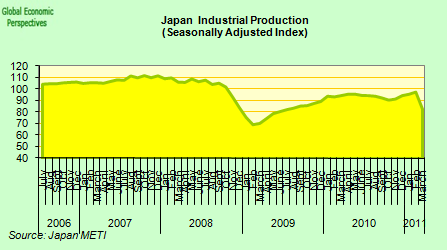
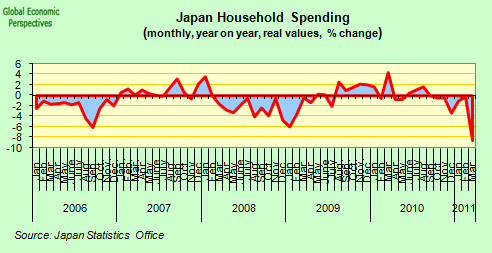
Large as they are, however, these numbers were to some extent expected. More worrisome from the Japanese point of view is the fact that production may be many months getting back to earlier levels given supply chain problems and the fact that electricity generating capacity will remain problematic, leading to reductions in the level of power available.
These delays in restoring production in Japan’s auto industry at a time of substantial economic growth in potential new markets raise the prospect that some of the damage may be permanent, as some part of the Japanese market share goes to the country’s main competitors. Indeed just this point was raised by S&P recently when it cut its outlook to negative for all three manufacturers along with suppliers Aisin Seiki (ASEKF.PK), Denso (DNZOF.PK) and Toyota Industries (TYIDY.PK). In their report justifying the move S&P stated: “The outlook revisions also reflect our opinion that extended production cuts may erode Japanese automakers’ market shares and competitive positions in the longer term.”
Among companies that may well inadvertently benefit from Japan’s ill fortune is the US is General Motors (GM), which less than two years after declaring themselves bankrupt now seems poised to reclaim the global auto sales number one spot from struggling rival Toyota. Japan’s car manufacturers have also been hurt by the sharp rise in the value of the yen. After years of a weak yen boosting sales and corporate profits, the Japanese currency has steadily strengthened to 81 yen to the dollar from 112 at the end of 2007. What might have been seen as a temporary development now looks much more permanent, and strategic planning by Japanese corporates will undoubtedly be influenced by this when it comes to decisions on where to locate new plant and capacity. And in the meanwhile, they stand to loose market share in both the US and in the key growth market, China.
German manufacturing is also an indirect beneficiary of Japan’s ills, and the German April manufacturing PMI once more revealed a very strong performance, underpinned by ex-European demand for capital and intermediate goods.
http://altlanticinternationalpartnership.net/2011/05/loading-symbols-authors-japans-economy-struggles-for-air/
Atlantic International Partnership Headlines:Money literally could not buy this kind of publicity for Brand Britain
What does the UK economy get out of the Royal wedding? That might seem a rather nerdy question to pose, just the sort of question that justifies economics’ soubriquet of “the dismal science”.
Any tally of the additional money spent by visitors, setting that off against the loss of output because of the extra bank holiday, does have a dismal ring to it. But what lifts the whole matter to a different level is the value and role of a brand. On its ability to attract a global television audience, the British Royal family would appear to be the greatest brand on earth. But is it worth anything?
On conventional arithmetic the impact of the wedding on the economy looks to be broadly neutral, maybe slightly positive. On the one hand it is disruptive, not just because of the extra day of holiday but because it comes in the middle of a whole wodge of extra days off, with the late Easter jumbling up with the early May bank holiday. You would normally expect any lost output to be recovered quickly, as common sense would suggest. But if you look back at the precedent of the Queen’s Golden Jubilee in June 2002, there was indeed a sharp fall in industrial output that was not immediately offset by subsequent gains.
On the other hand, the wedding is global in a way the jubilee was not and the commercial sector in London has responded vigorously to the occasion, with all sorts of incentives for visitors to part with their cash. There has been a boom in tourist numbers with estimates varying from 200,000 to 600,000 extra visitors. And I suppose all those foreign news crews who were developing coverage for the two billion viewers must have spent a fair amount extra too.
PricewaterhouseCoopers (PwC) has attempted to put some numbers on this whole thing, estimating that some 550,000 people will witness the event in or around Westminster; that 560,000 people will have travelled to the capital and that the commercial benefit to the London economy would be £107m. That is helpful, particularly at a time such as this, but it is not huge in the context of a regional economy of upwards of £200bn a year. It depends on how you measure it, but I saw calculations recently that ranked the London economy as the third-largest in the world, behind only New York and Tokyo. PwC notes that the Olympics next year is expected to attract more than 10 times the number of visitors, and that they will stay for around a fortnight, not just a day.
Put all this together and I would guess that there is a net plus, particularly to London, but it will not be huge in the context of the whole economy. But in the longer term it reinforces the British brand, gaining publicity that money literally could not buy. No promotional video for the UK could conceivably do what this wedding does.
What does the UK economy get out of the Royal wedding? That might seem a rather nerdy question to pose, just the sort of question that justifies economics’ soubriquet of “the dismal science”.
Any tally of the additional money spent by visitors, setting that off against the loss of output because of the extra bank holiday, does have a dismal ring to it. But what lifts the whole matter to a different level is the value and role of a brand. On its ability to attract a global television audience, the British Royal family would appear to be the greatest brand on earth. But is it worth anything?
On conventional arithmetic the impact of the wedding on the economy looks to be broadly neutral, maybe slightly positive. On the one hand it is disruptive, not just because of the extra day of holiday but because it comes in the middle of a whole wodge of extra days off, with the late Easter jumbling up with the early May bank holiday. You would normally expect any lost output to be recovered quickly, as common sense would suggest. But if you look back at the precedent of the Queen’s Golden Jubilee in June 2002, there was indeed a sharp fall in industrial output that was not immediately offset by subsequent gains.
On the other hand, the wedding is global in a way the jubilee was not and the commercial sector in London has responded vigorously to the occasion, with all sorts of incentives for visitors to part with their cash. There has been a boom in tourist numbers with estimates varying from 200,000 to 600,000 extra visitors. And I suppose all those foreign news crews who were developing coverage for the two billion viewers must have spent a fair amount extra too.
PricewaterhouseCoopers (PwC) has attempted to put some numbers on this whole thing, estimating that some 550,000 people will witness the event in or around Westminster; that 560,000 people will have travelled to the capital and that the commercial benefit to the London economy would be £107m. That is helpful, particularly at a time such as this, but it is not huge in the context of a regional economy of upwards of £200bn a year. It depends on how you measure it, but I saw calculations recently that ranked the London economy as the third-largest in the world, behind only New York and Tokyo. PwC notes that the Olympics next year is expected to attract more than 10 times the number of visitors, and that they will stay for around a fortnight, not just a day.
Put all this together and I would guess that there is a net plus, particularly to London, but it will not be huge in the context of the whole economy. But in the longer term it reinforces the British brand, gaining publicity that money literally could not buy. No promotional video for the UK could conceivably do what this wedding does.
http://altlanticinternationalpartnership.net/2011/05/atlantic-international-partnership-headlinesmoney-literally-could-not-buy-this-kind-of-publicity-for-brand-britain/
Any tally of the additional money spent by visitors, setting that off against the loss of output because of the extra bank holiday, does have a dismal ring to it. But what lifts the whole matter to a different level is the value and role of a brand. On its ability to attract a global television audience, the British Royal family would appear to be the greatest brand on earth. But is it worth anything?
On conventional arithmetic the impact of the wedding on the economy looks to be broadly neutral, maybe slightly positive. On the one hand it is disruptive, not just because of the extra day of holiday but because it comes in the middle of a whole wodge of extra days off, with the late Easter jumbling up with the early May bank holiday. You would normally expect any lost output to be recovered quickly, as common sense would suggest. But if you look back at the precedent of the Queen’s Golden Jubilee in June 2002, there was indeed a sharp fall in industrial output that was not immediately offset by subsequent gains.
On the other hand, the wedding is global in a way the jubilee was not and the commercial sector in London has responded vigorously to the occasion, with all sorts of incentives for visitors to part with their cash. There has been a boom in tourist numbers with estimates varying from 200,000 to 600,000 extra visitors. And I suppose all those foreign news crews who were developing coverage for the two billion viewers must have spent a fair amount extra too.
PricewaterhouseCoopers (PwC) has attempted to put some numbers on this whole thing, estimating that some 550,000 people will witness the event in or around Westminster; that 560,000 people will have travelled to the capital and that the commercial benefit to the London economy would be £107m. That is helpful, particularly at a time such as this, but it is not huge in the context of a regional economy of upwards of £200bn a year. It depends on how you measure it, but I saw calculations recently that ranked the London economy as the third-largest in the world, behind only New York and Tokyo. PwC notes that the Olympics next year is expected to attract more than 10 times the number of visitors, and that they will stay for around a fortnight, not just a day.
Put all this together and I would guess that there is a net plus, particularly to London, but it will not be huge in the context of the whole economy. But in the longer term it reinforces the British brand, gaining publicity that money literally could not buy. No promotional video for the UK could conceivably do what this wedding does.
What does the UK economy get out of the Royal wedding? That might seem a rather nerdy question to pose, just the sort of question that justifies economics’ soubriquet of “the dismal science”.
Any tally of the additional money spent by visitors, setting that off against the loss of output because of the extra bank holiday, does have a dismal ring to it. But what lifts the whole matter to a different level is the value and role of a brand. On its ability to attract a global television audience, the British Royal family would appear to be the greatest brand on earth. But is it worth anything?
On conventional arithmetic the impact of the wedding on the economy looks to be broadly neutral, maybe slightly positive. On the one hand it is disruptive, not just because of the extra day of holiday but because it comes in the middle of a whole wodge of extra days off, with the late Easter jumbling up with the early May bank holiday. You would normally expect any lost output to be recovered quickly, as common sense would suggest. But if you look back at the precedent of the Queen’s Golden Jubilee in June 2002, there was indeed a sharp fall in industrial output that was not immediately offset by subsequent gains.
On the other hand, the wedding is global in a way the jubilee was not and the commercial sector in London has responded vigorously to the occasion, with all sorts of incentives for visitors to part with their cash. There has been a boom in tourist numbers with estimates varying from 200,000 to 600,000 extra visitors. And I suppose all those foreign news crews who were developing coverage for the two billion viewers must have spent a fair amount extra too.
PricewaterhouseCoopers (PwC) has attempted to put some numbers on this whole thing, estimating that some 550,000 people will witness the event in or around Westminster; that 560,000 people will have travelled to the capital and that the commercial benefit to the London economy would be £107m. That is helpful, particularly at a time such as this, but it is not huge in the context of a regional economy of upwards of £200bn a year. It depends on how you measure it, but I saw calculations recently that ranked the London economy as the third-largest in the world, behind only New York and Tokyo. PwC notes that the Olympics next year is expected to attract more than 10 times the number of visitors, and that they will stay for around a fortnight, not just a day.
Put all this together and I would guess that there is a net plus, particularly to London, but it will not be huge in the context of the whole economy. But in the longer term it reinforces the British brand, gaining publicity that money literally could not buy. No promotional video for the UK could conceivably do what this wedding does.
http://altlanticinternationalpartnership.net/2011/05/atlantic-international-partnership-headlinesmoney-literally-could-not-buy-this-kind-of-publicity-for-brand-britain/
Atlantic International Partnership Headlines:Pakistan warns U.S.: No more raids
Officials say there would be “disastrous consequences” if U.S. executes more unauthorized operations, but stop short of calling bin Laden raid illegal

(CBS/AP)
ISLAMABAD – Pakistan warned America Thursday of “disastrous consequences” if it carries out any more unauthorized raids against suspected terrorists like the one that killed Osama bin Laden.
However, the government in Islamabad stopped short of labeling Monday’s helicopter raid on bin Laden’s compound not far from the capital Islamabad as an illegal operation and insisted relations between Washington and Islamabad remain on course.
The army and the government have come under criticism domestically for allowing the country’s sovereignty to be violated. Some critics have expressed doubts about government claims that it was not aware of the raid until after it was over.
Special Report: The Killing of Osama bin Laden
Foreign Secretary Salman Bashir’s remarks seemed to be aimed chiefly at addressing that criticism.
“The Pakistan security forces are neither incompetent nor negligent about their sacred duty to protect Pakistan,” he told reporters. “There shall not be any doubt that any repetition of such an act will have disastrous consequences,” he said.
Bashir repeated Pakistani claims that it did not know anything about the raid until it was too late to stop it. He said the army scrambled two F-16 fighter jets when it was aware that foreign helicopters were hovering over the city of Abbottabad, but they apparently did not get to the choppers on time.
http://altlanticinternationalpartnership.net/2011/05/atlantic-international-partnership-headlinespakistan-warns-u-s-no-more-raids/

(CBS/AP)
ISLAMABAD – Pakistan warned America Thursday of “disastrous consequences” if it carries out any more unauthorized raids against suspected terrorists like the one that killed Osama bin Laden.
However, the government in Islamabad stopped short of labeling Monday’s helicopter raid on bin Laden’s compound not far from the capital Islamabad as an illegal operation and insisted relations between Washington and Islamabad remain on course.
The army and the government have come under criticism domestically for allowing the country’s sovereignty to be violated. Some critics have expressed doubts about government claims that it was not aware of the raid until after it was over.
Special Report: The Killing of Osama bin Laden
Foreign Secretary Salman Bashir’s remarks seemed to be aimed chiefly at addressing that criticism.
“The Pakistan security forces are neither incompetent nor negligent about their sacred duty to protect Pakistan,” he told reporters. “There shall not be any doubt that any repetition of such an act will have disastrous consequences,” he said.
Bashir repeated Pakistani claims that it did not know anything about the raid until it was too late to stop it. He said the army scrambled two F-16 fighter jets when it was aware that foreign helicopters were hovering over the city of Abbottabad, but they apparently did not get to the choppers on time.
http://altlanticinternationalpartnership.net/2011/05/atlantic-international-partnership-headlinespakistan-warns-u-s-no-more-raids/
Atlantic International Partnership Headlines: Sony CEO sorry for PlayStation woes
Sony CEO Howard Stringer has apologized for the PlayStation attack and promised service will be up and running again soon.
Stringer’s apology was one of several updates Sony has posted recently in its PlayStation blog.
Here is part of Stringer’s post:
The Japanese company later admitted that its Sony Online Entertainment (SOE) division, previously thought to be untouched by the hack that shuttered its PlayStation Network, had also been compromised.
Sony said it believes hackers stole personal information from about 25 million users and that the credit card information for some non-U.S. customers may have been taken
http://altlanticinternationalpartnership.net/2011/05/atlantic-international-partnership-headlines-sony-ceo-sorry-for-playstation-woes/
Stringer’s apology was one of several updates Sony has posted recently in its PlayStation blog.
Here is part of Stringer’s post:
To date, there is no confirmed evidence any credit card or personal information has been misused, and we continue to monitor the situation closely. We are also moving ahead with plans to help protect our customers from identity theft around the world. A program for U.S. PlayStation Network and Qriocity customers that includes a $1 million identity theft insurance policy per user was launched earlier today and announcements for other regions will be coming soon.In mid April, Sony’s PlayStation Network and Qriocity, its media streaming service, were shut down after a hacker attack.
The Japanese company later admitted that its Sony Online Entertainment (SOE) division, previously thought to be untouched by the hack that shuttered its PlayStation Network, had also been compromised.
Sony said it believes hackers stole personal information from about 25 million users and that the credit card information for some non-U.S. customers may have been taken
http://altlanticinternationalpartnership.net/2011/05/atlantic-international-partnership-headlines-sony-ceo-sorry-for-playstation-woes/
Atlantic International Partnership Headlines: China as Number One? Don’t Bet Your Bottom Dollar
Tired of Afghanistan and all those messy, oil-ish wars in the Greater Middle East that just don’t seem to pan out? Count on one thing: part of the U.S. military feels just the way you do, especially a largely sidelined Navy — and that’s undoubtedly one of the reasons why, a few months back, the specter of China as this country’s future enemy once again reared its ugly head.
Back before 9/11, China was, of course, the favored future uber-enemy of Secretary of Defense Donald Rumsfeld and all those neocons who signed onto the Project for the New American Century and later staffed George W. Bush’s administration. After all, if you wanted to build a military beyond compare to enforce a long-term Pax Americana on the planet, you needed a nightmare enemy large enough to justify all the advanced weapons systems in which you planned to invest.
As late as June 2005, neocon journalist Robert Kaplan was still writing in the Atlantic about “How We Would Fight China,” an article with this provocative subhead: “The Middle East is just a blip. The American military contest with China in the Pacific will define the twenty-first century. And China will be a more formidable adversary than Russia ever was.” As everyone knows, however, that “blip” proved far too much for the Bush administration.
Finding itself hopelessly bogged down in two ground wars with rag-tag insurgency movements on either end of the Greater Middle Eastern “mainland,” it let China-as-Monster-Enemy slip beneath the waves. In the process, the Navy and, to some extent, the Air Force became adjunct services to the Army (and the Marines). In Iraq and Afghanistan, for instance, U.S. Navy personnel far from any body of water found themselves driving trucks and staffing prisons.
It was the worst of times for the admirals, and probably not so great for the flyboys either, particularly after Secretary of Defense Robert Gates began pushing pilotless drones as the true force of the future. Naturally, a no-dogfight world in which the U.S. military eternally engages enemies without significant air forces is a problematic basis for proposing future Air Force budgets.
There’s no reason to be surprised then that, as the war in Iraq began to wind down in 2009-2010, the “Chinese naval threat” began to quietly reemerge. China was, after all, immensely economically successful and beginning to flex its muscles in local territorial waters. The alarms sounded by military types or pundits associated with them grew stronger in the early months of 2011 (as did news of weapons systems being developed to deal with future Chinese air and sea power). “Beware America, time is running out!” warned retired Air Force lieutenant general and Fox News contributor Thomas G. McInerney while describing China’s first experimental stealth jet fighter.
Atlantic International Partnership Headlines: Dubai Financial Market’s First-Quarter Net Plunges 96% Amid Mideast Unrest
Dubai Financial Market (DFM) PJSC, the only Gulf Arab stock market to sell shares to the public, had a 96 percent plunge in first-quarter profit as trading volumes declined amid political unrest in the Middle East.
Net income for the quarter ended March 31 was 2.18 million dirhams ($594,000), the exchange said in an e-mailed statement today, without giving comparative numbers for the year-earlier period. The bourse had a profit of 53.58 million dirhams in the first quarter of 2010, according to Bloomberg data.
First-quarter trading volumes dropped to a daily average of 116 million from 235 million in the year-earlier period as political unrest toppled leaders in Tunisia and Egypt, according to data compiled by Bloomberg data. Abdullah Al Turaifi, chief executive officer of the Securities & Commodities Authority, said in February the market regulator would support a merger between the exchanges in Dubai and neighboring Abu Dhabi.
“Dubai Financial Market pursues an ambitious strategy to diversify revenue streams and downscale reliance on trading commissions as the main source of income,” Chairman Abdul Jalil Yousef Darwish said in the statement. “Since the beginning of this year we have started the implementation of this strategy, which will reflect positively on our revenue and profit and maximize shareholders’ value.”
Shares of Dubai Financial Market fell 1.5 percent to 1.31 dirhams at the 2 p.m. close in Dubai today. The stock has lost 13 percent this year compared with a 2.4 percent decline in the benchmark Dubai Financial Market General Index.
Signing Agreements
Revenue for the first quarter was 48.7 million dirhams, comprising 33.6 million dirhams of operating income and 15.1 million dirhams in investment returns, the company said. The value of shares traded was 10.9 billion dirhams during the quarter, it said, without giving year-earlier figures.
Dubai Financial Market in that past few months signed agreements to sell market data to 14 local, regional and international data vendors and applied listing fees in April, Chief Executive Officer Essa Kazim said in the statement.
The U.A.E., the second-biggest Arab economy, is home to the Dubai Financial Market, Abu Dhabi Securities Exchange and Nasdaq Dubai. Dubai Financial Market and Abu Dhabi Securities Exchange are implementing systems to qualify for an upgrade to emerging market status at index provider MSCI Inc. (MSCI)
Dubai’s benchmark has gained 18 percent since reaching an almost seven year-low on March 3. The gauge fell 1 percent today.
Time for Brokerages
The United Arab Emirates’ stock exchanges will give brokerages until May 29 to switch to the so-called delivery- versus-payment system, one of MSCI’s criteria for the country’s upgrade. MSCI in June cited a dual account structure as one of the reasons for frontier market status of the U.A.E. and kept the country under review for reclassification. MSCI will reassess the ranking next month, according to its website.
http://altlanticinternationalpartnership.net/2011/05/atlantic-international-partnership-headlines-dubai-financial-market%E2%80%99s-first-quarter-net-plunges-96-amid-mideast-unrest/
Net income for the quarter ended March 31 was 2.18 million dirhams ($594,000), the exchange said in an e-mailed statement today, without giving comparative numbers for the year-earlier period. The bourse had a profit of 53.58 million dirhams in the first quarter of 2010, according to Bloomberg data.
First-quarter trading volumes dropped to a daily average of 116 million from 235 million in the year-earlier period as political unrest toppled leaders in Tunisia and Egypt, according to data compiled by Bloomberg data. Abdullah Al Turaifi, chief executive officer of the Securities & Commodities Authority, said in February the market regulator would support a merger between the exchanges in Dubai and neighboring Abu Dhabi.
“Dubai Financial Market pursues an ambitious strategy to diversify revenue streams and downscale reliance on trading commissions as the main source of income,” Chairman Abdul Jalil Yousef Darwish said in the statement. “Since the beginning of this year we have started the implementation of this strategy, which will reflect positively on our revenue and profit and maximize shareholders’ value.”
Shares of Dubai Financial Market fell 1.5 percent to 1.31 dirhams at the 2 p.m. close in Dubai today. The stock has lost 13 percent this year compared with a 2.4 percent decline in the benchmark Dubai Financial Market General Index.
Signing Agreements
Revenue for the first quarter was 48.7 million dirhams, comprising 33.6 million dirhams of operating income and 15.1 million dirhams in investment returns, the company said. The value of shares traded was 10.9 billion dirhams during the quarter, it said, without giving year-earlier figures.
Dubai Financial Market in that past few months signed agreements to sell market data to 14 local, regional and international data vendors and applied listing fees in April, Chief Executive Officer Essa Kazim said in the statement.
The U.A.E., the second-biggest Arab economy, is home to the Dubai Financial Market, Abu Dhabi Securities Exchange and Nasdaq Dubai. Dubai Financial Market and Abu Dhabi Securities Exchange are implementing systems to qualify for an upgrade to emerging market status at index provider MSCI Inc. (MSCI)
Dubai’s benchmark has gained 18 percent since reaching an almost seven year-low on March 3. The gauge fell 1 percent today.
Time for Brokerages
The United Arab Emirates’ stock exchanges will give brokerages until May 29 to switch to the so-called delivery- versus-payment system, one of MSCI’s criteria for the country’s upgrade. MSCI in June cited a dual account structure as one of the reasons for frontier market status of the U.A.E. and kept the country under review for reclassification. MSCI will reassess the ranking next month, according to its website.
http://altlanticinternationalpartnership.net/2011/05/atlantic-international-partnership-headlines-dubai-financial-market%E2%80%99s-first-quarter-net-plunges-96-amid-mideast-unrest/
fredag 6. mai 2011
Altlantic International Partnership news: More women take financial lead in household
DALLAS -- Many couples run their households jointly, making financial decisions together as partners.
But more and more women are taking on the role of their family's chief financial officer. They set the budget, pay the bills, make the grocery list and can tell you how much it truly costs to run the family.
"Over the last five years, we have seen a significant increase with the clients and potential clients we have interviewed where the female in the relationship is either taking the lead in the decision-making process or at a minimum is involved in setting the objectives and risk tolerances for the family finances," said Karen Burns, president of Capital Ideas, a Dallas investment firm.
"This is a dramatic change from when my partner first entered the investment world more than 40 years ago and a significant change from when I entered the business in 1995."
In the past, her firm "rarely met the female spouses in our strategy meetings with our clients," she said. "And now, most of the couples we deal with include either both spouses and frequently just the female."
Experts say part of the reason for the change is that more women are earning their own money and becoming financially self-sufficient.
"As they become breadwinners, we're seeing them taking on more of the longer-term finances," said Lule Demmissie, managing director of investment products and retirement at TD Ameritrade. "The reality is that women
Advertisement


Stephanie Stoltzfus of North Richland Hills took over her family's finances in 2005 to help her husband, David, who had started a new job as an escrow officer at a title company.
"He was pretty wiped out at the end of the day," said Stoltzfus, 46, who was working part time then as a hairdresser. "He didn't want to deal with it because he deals with numbers all day long."
The couple's stage in life -- they were newly married and were beginning to consolidate things -- also called for her to manage the finances.
"I felt we were going through a lot of change, and I needed to step up and help him," Stoltzfus said.
Now Stoltzfus is a full-time mom to three adopted children and family CFO, managing the household mainly on her husband's salary.
Using Stoltzfus' experience, here's some advice for women who take over the finance duties of their family:
Organize your records: "Get a system that works for you," she said. "If you pay something late, you get a late fee, especially on credit cards. You really have to stay on top of it."
Stoltzfus uses online banking, as well as an organizer in which she files her bills. She records each bill's due date, the amount and what the bill is for.
If the role of family CFO has been suddenly thrust upon you, your first task may be to find all the financial records.
Learn to budget: Stoltzfus was comfortable with managing money because she had done so when she was single.
However, "managing a family is a whole lot different, which is something I wasn't used to," said Stoltzfus, whose three children are 9, 8 and 5.
"When you're just managing yourself, you're not having to consider as many other opportunities of spending," she said. "You're just considering just the things you would spend on."
But that changes once you become a parent, Stoltzfus said.
"Once you have your family and your family begins to grow and your kids begin to have more of an opinion of what they want to wear and what they want to eat, you have to begin to broaden your spectrum and do more budgeting," she said.
Set financial limits: "What are the financial boundaries for our family?" is a key question Stoltzfus asks often.
"There are school pictures, sports, extracurricular activities. It's just never-ending," she said.
So like a corporate CFO, Stoltzfus has had to lay down the law on what to buy and not buy for her kids.
http://www.mercurynews.com/personal-finance/ci_17923993?nclick_check=1
Altlantic International Partnership news: Bin Laden's Death Reverberates in Media and Economy
The demise of terrorist Osama bin Laden continued to shake up the world on Monday as details spread of a daring raid by U.S. Navy Seals that took out the Al Qaeda leader. There was an early surge in stock prices, and oil initially fell more than three percent, but skepticism about the future of the Middle East soon caused a correction, Reuters reported.
Traditional vs Social Media
The event was also an extravaganza for conventional media as well as emerging social-media communications. TV networks broke into their regularly scheduled programming around 10:40 p.m. Eastern time Sunday night to announce the news after the White House sent out an advisory that President Barack Obama would address the nation. That didn't happen for almost an hour, leaving correspondents such as Geraldo Rivera of Fox and Wolf Blitzer of CNN awkwardly grasping for information, frequently shifting between commentators and file footage of bin Laden while waiting for details.
Meanwhile, the social-media infrastructure, which was in its infancy when the Sept. 11, 2001, World Trade Center attacks occurred, faced perhaps the biggest worldwide news event since then, except perhaps the election of Obama in 2008.
Twitter reported a new record of both average tweets per second and an all-time per-second high during the president's brief speech and the aftermath. "Last night saw the highest sustained rate of tweets ever" at 3,440, the company reported, with a peak of 5,106 around 11 p.m. EDT, when many TV viewers were tuning into the late news.
"Facebook and Twitter are exploding today with comments, reposting of news stories, and a good bit of humor/commentary," Professor Davis Houck of the Florida State University School of Communication told us. "When the story broke [Sunday] night on social media, I'm guessing many quickly sought out more traditional media, notably television, especially given that President Obama would soon be addressing the nation. As this week begins, though, social media is again buzzing with the latest ... news updates and, again, a good bit of humor."
http://business.newsfactor.com/story.xhtml?story_id=0030009Z5F7O&full_skip=1
Traditional vs Social Media
The event was also an extravaganza for conventional media as well as emerging social-media communications. TV networks broke into their regularly scheduled programming around 10:40 p.m. Eastern time Sunday night to announce the news after the White House sent out an advisory that President Barack Obama would address the nation. That didn't happen for almost an hour, leaving correspondents such as Geraldo Rivera of Fox and Wolf Blitzer of CNN awkwardly grasping for information, frequently shifting between commentators and file footage of bin Laden while waiting for details.
Meanwhile, the social-media infrastructure
, which was in its infancy when the Sept. 11, 2001, World Trade Center attacks occurred, faced perhaps the biggest worldwide news event since then, except perhaps the election of Obama in 2008. Twitter reported a new record of both average tweets per second and an all-time per-second high during the president's brief speech and the aftermath. "Last night saw the highest sustained rate of tweets ever" at 3,440, the company reported, with a peak of 5,106 around 11 p.m. EDT, when many TV viewers were tuning into the late news.
"Facebook and Twitter are exploding today with comments, reposting of news stories, and a good bit of humor/commentary," Professor Davis Houck of the Florida State University School of Communication told us. "When the story broke [Sunday] night on social media, I'm guessing many quickly sought out more traditional media, notably television, especially given that President Obama would soon be addressing the nation. As this week begins, though, social media is again buzzing with the latest ... news updates and, again, a good bit of humor."
http://business.newsfactor.com/story.xhtml?story_id=0030009Z5F7O&full_skip=1
Abonner på:
Innlegg (Atom)